This week has a bit of everything: distributed systems war stories from Netflix, a rapid-fire catalogue of Claude Code updates you probably missed, and Anthropic explaining how a million lines of Zig became Rust in under two weeks. The common thread? Agents are doing serious engineering work, and the process discipline that makes it possible.
But there’s also a cautionary tale that should make every one of us reach for mitmproxy: a security researcher caught xAI’s Grok Build coding agent uploading 27,800 times more data than the task required, entire repos, secrets included. Trust, but verify on the wire.
Distributed Computing
-
Building Service Topology at Scale: Architecture, Challenges, and Lessons Learned. In this post, Parth Jain and colleagues on the Netflix Observability team deliver a 20-minute masterclass in what happens when a beautiful architecture meets ugly production reality. The mission: a real-time service dependency map at Netflix scale, built streaming-first because during a 3am incident, an hour-old topology map is “archaeology, not observability”. The heart of the system is a three-stage distributed aggregation pipeline that resolves network intermediaries, turning App A → Load Balancer → App B flow logs into the App A → App B edges engineers actually care about, with reactive streams and backpressure keeping millions of flow records per second from toppling the whole thing over.
The war stories are the best part. Kafka consumers fell hours behind. “Hot nodes” received 100x the traffic of their neighbours because popular services like authentication dominate flow volume, and consistent hashing dutifully routed all of it to one poor instance. Garbage collection consumed more CPU than the business logic, and the fix list reads like a heresy trial against conventional wisdom: they ripped out gRPC in favour of humble Server-Sent Events and, gasp, abandoned Scala’s beloved immutability for mutable aggregators on the hot path, cutting heap allocation by over 50%. There’s also a genuinely elegant time-travel capability: 5-minute aggregator snapshots plus property-level mutation tracking let engineers reconstruct what the topology looked like at the exact moment an incident started.
What I find most valuable here is the recurring lesson, stated three different ways: best practices are starting points, not absolute rules. gRPC is “industry best practice” until it’s your bottleneck; immutability is a virtue until the garbage collector is doing more work than your business logic. Measure, don’t assume. Those of us from the database world have been preaching this for decades; the query plan doesn’t care about your style guide, and it’s oddly comforting to watch the streaming-systems crowd arrive at the same conclusion. If you build data pipelines of any kind, read this one twice.
Generative AI
-
8 Claude Code Updates You Likely Missed (Agents Now Open Your PRs). This post by Joe Njenga does the community a solid by trawling through the last 15 Claude Code releases and pulling out the eight changes that actually matter, because let’s be honest, nobody reads patch notes. The headline change: background agents launched from
claude agentsnow finish the job properly, committing the code with a conventional message, pushing the branch, and opening a draft pull request on GitHub. You dispatch a task, go get coffee (or attend yet another meeting), and come back to a PR waiting for review.The rest of the list is just as useful. Subagents now run in the background by default, fanning out in parallel instead of pausing the main session.
/doctorhas grown from a diagnostics tool into a full setup checkup that actually fixes what it finds, MCP auth, plugin errors, worktree issues and all. You can stack up to five slash skills in a single prompt, control dynamic workflow size (small, medium, large) from/config, and Claude in Chrome has graduated from preview to general availability. Two smaller quality-of-life wins round it out: AskUserQuestion dialogues now wait indefinitely instead of auto-continuing with an answer you never approved, and Claude Code warns you before your login expires rather than letting background sessions die mid-task.Here’s what strikes me about this list as a whole: nearly every item is about making Claude Code a better unattended worker. PRs opened automatically, subagents in the background, dialogues that wait patiently for you, auth that doesn’t collapse overnight, this is the infrastructure of fire-and-forget agentic development. The AskUserQuestion change is my favourite, precisely because it’s the least flashy: an agent that silently proceeds with a default answer you never approved is an agent you can’t trust with anything important. Small fix, big trust dividend.
-
Musk’s Coding Agent Uploaded 27,800x More Data Than the Task Needed — Your Whole Repo, Secrets Included. Chew Loong Nian, in this post looks at the week’s biggest security story: a wire-level audit of xAI’s Grok Build CLI showing that while the model turn needed 192 KB, the storage channel quietly moved 5.1 GiB, the researcher’s entire repository, packaged as a git bundle and shipped to a Google Cloud Storage bucket named
grok-code-session-tracesthat no setup doc ever mentioned. The canary experiment removes all doubt: a never-read file, an explicit prompt of “Reply with exactly: OK. Do not read or open any files.”, and the wire capture still recorded the full repo, including that file, leaving the machine. Users on Hacker News reported that entire home directories, SSH keys, and password-manager databases were being swept up.The detail every engineering leader should sit with is the privacy toggle that did nothing. Turning off “Improve the model” governed training, not collection, the repo uploaded either way, into deliberate, versioned, content-addressed infrastructure built by a first-party Rust crate literally named
xai-data-collector. The fix, when it came after the story went viral, was a server-side flag, which means the upload code still ships in the binary, one config push away from being turned back on. To the author’s credit, he’s careful about what was and wasn’t proven: uploads were measured, training on the data was not.The genuinely useful part is the reproducible 15-minute audit recipe: mitmproxy, a canary repo with unique markers in
.envand a never-read file, a do-nothing prompt as the control, then three questions of the capture log. Which hosts got traffic? Do the canaries appear? Does anything fire after the model has answered? He runs through five hardening moves too, secrets out of tracked files, agents in scoped directories rather than$HOME, contractual zero-data-retention tiers, explicit off-switches, and egress allowlists for anything sensitive.I keep wrestling with the structural lesson here, because it applies to every vendor, not just xAI: training data is the scarcest resource in AI. Hence, the incentive that built
xai-data-collectoris universal, and the gap between what an agent needs and what it takes is invisible unless someone measures it. One anonymous researcher, using a proxy, moved an entire company’s data practices in 48 hours. The takeaway isn’t “switch agents”, it’s “audit the one you have”, and after reading this, I know what I’m doing with a spare 15 minutes this week. Oh, and am I surprised to see what Grok did? No, not at all! I am not surprised at all; this is, after all, Musk we are talking about.
-
How Anthropic runs large-scale code migrations with Claude Code. In this post by Anthropic, we get the step-by-step playbook behind two eye-watering migrations: Jarred Sumner (of Bun fame) porting a million lines of Bun from Zig to Rust in under two weeks, with 100% of the existing test suite passing in CI before merge, and Mike Krieger porting a Python codebase to 165,000 lines of TypeScript over a weekend, complete with hundreds of agents, eight phase gates, and three adversarial review rounds. The economics are stark: what used to be a $3-4 million, four-year mega-project now costs tens to hundreds of thousands of dollars, the Bun migration burned 5.9 billion uncached input tokens, roughly $165,000 at API pricing, and the worst-case scenario has shrunk from “two parallel codebases for years” to “delete the branch and try again”.
The core insight deserves framing on a wall: you don’t fix the code, you fix the process (loop) that produced the code. Everything follows from that. The prerequisite is a strong judge, a test suite or parity harness that can evaluate both codebases on equal terms, validated by confirming it fails on deliberately broken code. Then six steps: build a rulebook, dependency map, and gap inventory; stress-test the rules on a mini-migration (Jarred caught two critical issues before they fanned out across 1,448 files); translate everything with implementer agents reviewed by adversarial pairs; then compile, run, and match behaviour in progressively more mechanical loops. When a reviewer keeps catching the same mistake, you don’t patch files; you add one sentence to the rulebook and regenerate the batch. Mike’s finishing move is delightful: Claude designed its own end-to-end test suite and ran it autonomously overnight, four nights in a row, fixing what broke.
The best practices section is full of hard-won pragmatism: make review adversarial and verification mechanical, let scripts be the referee, and don’t use the largest model for everything. Mike fanned out Claude Sonnet for the high-volume implementation work and saved the big guns for reviewers and rule-writers. Done should mean “the output file exists on disk”, making the whole migration resumable by construction.
What fascinates me is how much this echoes my own, admittedly much smaller-scale, experience with the Event Management System series: the leverage is never in the individual fix, it’s in the rulebook and the loop. Every time I’ve hand-patched something Claude got wrong, the same bug came back in the next generation; every time I’ve fixed the instructions instead, it stayed fixed. Anthropic has essentially industrialised that observation with compilers and test suites as referees. And the closing provocation is one I’d echo to every team nursing a legacy codebase: it might be time to re-run the math on that long-deferred migration.
WIND (What Is Niels Doing)
One week to go! Data & AI Community Day Durban: AI Unplugged II - The Maskandi Sessions happens this coming Saturday, July 25, at Richfield College’s Umhlanga Campus. As I mentioned last week, we sold out in under 48 hours, but we’ve now managed to squeeze out a little more capacity, which means everyone on the waiting list has been issued complimentary tickets. If that’s you, check your inbox!
Yesterday was a full day of event admin, and I’m happy to report we’re in a really good place going into the final week. A special word about our sponsors: they are all sorted, and I am genuinely amazed by their generosity:
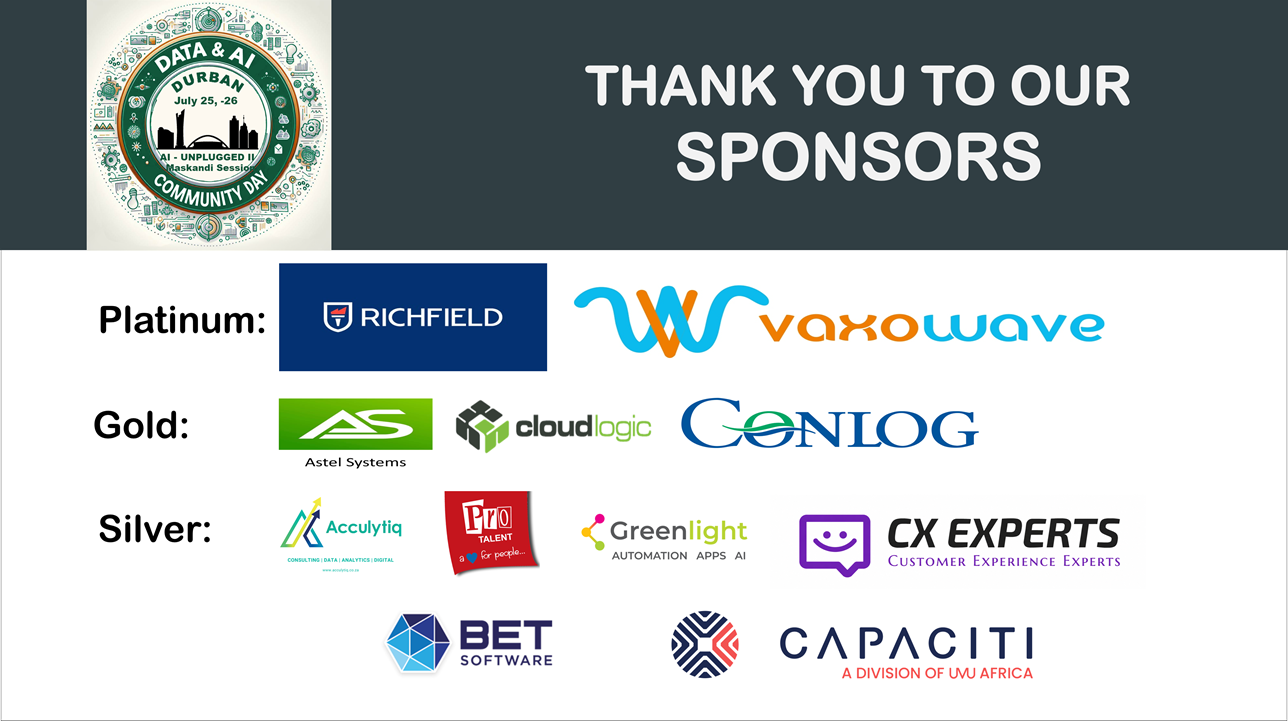
Community events like this do not happen without them, so to every sponsor who stepped up, thank you. See you all on Saturday!
~ Finally
That’s all for this week. I hope you find this information valuable. Please share your thoughts and ideas on this post, or ping me with suggestions for future topics. Your input is highly valued and can help shape the direction of our discussions.
I look forward to hearing from you.